Thursday, September 16, 2010

"A Hard Rain's Gonna Fall" / Edie Brickell / Born on the Fourth of July Soundtrack

In high school in the late 80's, every girl I was friends with, and I mean EVERY girl, loved Edie Brickell. The Shooting Rubberbands at the Stars CD was a musical female Bible; she was the patron saint of the thoughtful, disaffected, moody teenage girl. Diaries, classroom folders and yearbooks had scribbled lyrics from "Circle". She just seemed to capture the zeitgeist of what it meant to be a adolescent girl back then.

And I'm not gonna lie, it wasn't too bad. Edie was easy on the eyes, and the music was nice when one was in the mood for some mellow tunes. I actually really liked the single "Mama Help Me" off of her follow-up album, but that was a litle bit darker and less accessable and didn't prove to be much of a hit. Then Brickell went on to marry Paul Simon, have some guiar stumming folkie babies, and was hardly heard from again(save the odd release).

In 1989, at the height of Brickell's popularity, the Tom Cruise war film Born on the Fourth of July was released. The soundtrack contained Brickell's perfect cover of this Bob Dylan song.

Here's the thing about Dylan: at the rick of losing any musical credentials I may have among people and alienating my Dylan-worshiping in-laws, I'm just really not a fan. I recognize his significant cultural impact, I appreciate his skill as a songwriter, but the perfomance just has never done it for me. The sloppiness of the music, the inscrutable, pretentious lyrics, that voice (though this is coming from a dude whose favorite band is led by Geddy Lee, so take it with a grain of salt), it's never worked for me.

Now songs that are Dylan covers I generally like. Of course, there's Hendix's "All Along the Watchtower" (considered by many to be the greatest cover of all time); I just recently heard a cover of "Girl From the North Country" by Lions on Sons of Anarchy - an incredible song that I downloaded before I even realized it was a Dylan cover, and there's this Brickell cover here. Dylan can compose a hell of a song, but his performance just leaves something to be desired.

I've never heard the original of this song, and it's probably just as well, because I always listen to this without any preconceptions or comparisons. It made sense once I found it out, though, as you can recognize some classic Dylan elements such as the wordiness, the odd imagery, the symbolism and the folk structure.

Brickell's gorgeous voice probably gives the song the biggest improvement. My favorite part of the song is the very beginning with the strummed intro and her crystal-clear tone lulling

Oh where have you been, my blue-eyed son?
Oh where have you been, my darling young one?


(And check out the chord change on the second "one" there - what a great punch, and it's repeated throughout the song)

The first verse is just Edie and the guitar, which is nice, but it's best just to ignore the lyrics about misty mountains, sad forests and dead oceans. I mean, I consider myself pretty well versed in poetic devices and symbolism, but come on. After the chorus, she adds more instrumentation, which makes the drop back to just her voice and the guitar very effective at the beginning of the third verse (3:03).

After that, I love the slow build from quiet to loud as Brickell takes advantage of the "Where the...." refrain which is repeated over and over and builds tension and intensity, finally dropping it off at 4:27, (on the word "sinking"). Finally, a really nice job with the false ending, "I'll know my song well before I start singing" and trailing off with a false ending at 4:34 before poping out with the chorus once more, and I just love how she belts that bad boy out - I still get chills when she hits the "Raaaaaain" high note at the end of the song.


Here's Dylan's version

Saturday, August 21, 2010

"Damage, Inc." / Metallica / Master of Puppets

Oh, Metallica…*sighs, shakes head*

Back in high school in the late 80's, Metallica was probably my favorite band. To this day, one of the best shows I've ever seen was Metallica and the Cult (with Steve Jones!) at Atlanta's Lakewood Amphitheatre on the "...And Justice for All..." tour in 1989. Then came the pile of crap called the "Black Album". Then came forcing Jason Newstead out, then Lars and Napster, a shameful episode that found a band taking its fans to court, more crap albums, and you have what you've got now.

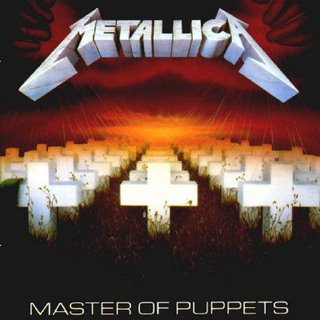
Seriously…they went from this:

To this:


Metallica is a band at which I can pinpoint the first time I heard them. I was on a family vacation to Jekyll Island in 1986 between my freshman and sophomore years of high school. I was all about the classics at that time – Zeppelin, Floyd, Rush, etc. I met a kid down at the condo at which we were staying who was into music too. I had just bought Electric by The Cult and was really digging that “tape”. I told this kid to check it out, and he slipped it in his walkman.

He took a listen, grinned, and said, “Not too bad. Now you listen to this” and then handed over Master of Puppets.


Just the imagery of the tape cover told me I was in for something new and exciting, something semi-dangerous and challenging. As I stared at the picture of rows of graves under a blood red sky, I hit play and heard the first chugging chords of “Disposable Heroes”

Some seven minutes later, I turned the tape player off and looked at the kid. I’m sure my eyes were big as saucers because of the big smile on his face, “Good stuff, huh?” he said as he took his tape back.

It wasn’t as if I hadn’t ever listened to anything out of the mainstream. In ninth grade I tried on punk for size, but it was nothing to the euphoric feeling I got from Metallica.

This is one reason I hate them so much today : to go from being so great and important (not just to me, but important musically) to geezers today feels like a complete betrayal. Add to that Lars Ulrich’s and James Hetfield’s general douchiness , and they are just so easy to hate (pity Kirk Hamnett, who always seems like an easygoing fellow, and the sting of bass players - Cliff Burton, Jason Newstead and currently Robert Trullilo – who forever seem like the coolest dudes in the group whenever they are in it).

So let’s remember the good times with “Damage, Inc.”, shall we?

The final song off of the aforementioned Master of Puppets, it’s one of the group’s most famous and lasting. It begins with some slow, building guitar work from Kirk before breaking into the classic Metallica crunch at 1:20. Even for a Metallica tune, it’s a damn scorcher, roaring along at breakneck speed.

At 1:50 they introduce the five-chord hook of the song, a descending riff which is one of the most recognizable in their canon. The lyrics tend toward the trite (“Living on your knees, conformity / or dying on your feet for honesty”) and cliched (”Fuck it all and fucking no regrets”) but have some nice imagery of blood, wild animals (razorbacks, jackals, hunt, instinct) and general mayhem (steamrollers, slamming, agony).

It’s more or less a “We are badass, don’t fuck with us” tune, the type they used to write in their sleep (“Hit the Lights”, “Whiplash”) before they completely quit trying.

Anyway, some last few cool part of Damage I love: the whispered song title, the bridge / breakdown at 3:14, the little drum fill and the “Go!” at the end of it (3:47) leading into Kirk’s killer solo, and my favorite part has always been the little syncopated twist they put on the main riff at the end of the song (5:19).

It’s really bittersweet to listen to the first four Metallica albums – Kill Em All, Ride the Lightning, Master of Puppets, and …And Justice for All. Those albums are about as close to perfection as hard rock music gets, and it’s just a shame to consider what’s become of them. I heard they can still bring it live, but they lost me long ago, unfortunately.

Wednesday, July 28, 2010

"Coward of the County" / Kenny Rogers / Greatest Hits

Kenny Rogers Greatest Hits holds a fair amount of nostalgia for me. When I was in second and third grade after I got off the bus to come home for the day, my Mom usually had a nice snack for me and was playing one of two albums: this one or The Oak Ridge Boys Greatest HIts. We would sit and have something to eat, chat about my day, then play a game of Clue or Life or something like that (I remember thinking that in "Lucille" I thought it was awfully unfair that the narrator's wife left him with "400 children and a crop in the field". Just wrong, that was)

One thing I love about this song and many of the classic country songs are that they're story songs. You can have a pretty nice complete narrative in three or four minutes in a great country song, sometimes with a nice ironic twist ending if you're lucky. Kenny's got some great ones too: besides this one and "Lucille", there's the classic "Gambler", and "Ruby, Don't Take Your Love to Town", about a VIetnam paraplegic who's begging his wife to stay with him (with the terrifying to me at that age line: "If I could move I'd get my gun and put her in the ground")

So what's going on in "Coward of the County"? A poor boy named Tommy is teased for running from fights ("The folks just called him Yella'" as the narrator says). There's more to that story, though. The song's narrator is the boy's uncle ("I looked after Tommy cause he was my brother's son") and is raising him because Tommy's Dad died in prison. So our narrator knows why Tommy won't fight; he heard the last words Tommy's father said to him, giving us the song's famous chorus:

Promise me, son, not to do the things I've done.
Walk away from trouble if you can.
It won't mean you're weak if you turn the other cheek.
I hope you're old enough to understand:
Son, you don't have to fight to be a man!"


It's not all bad for Tommy, though, he's in love with a girl named Becky. Unfortunately, some local miscreants the Gatlin boys see something they like in Becky too. The song describes the next event as such:

One day while he was workin' the Gatlin boys came callin'.
They took turns at Becky... and there was three of them!


Now, I really wasn't sure what "taking turns" meant when I was seven....but I was pretty sure that it wasn't good. Especially the way Kenny delivers the last part of that line - doesn't sing it, and pauses right before it to get the full effect (3:37 in the video)

Tommy comes in and sees Becky's "torn dress" and "shattered look", walks over to his Daddy's picture (and hears the words of the chorus again) and then turns as if to leave, prompting taunts from the Gatlin boys. Then comes the turning point of the song, spoken again, with another pause for emphasis:

But you could have heard a pin drop when Tommy stopped and locked the door


Tommy proceeds to kick the collective Gatlin boys' asses using "twenty years" of pent-up rage, then speaks again to his dead father, playing with the words of the chorus ever so slightly (and giving us our twist):

I promised you, dad, not to do the things you've done.
I walk away from trouble when I can.
Now please don't think I'm weak, I didn't turn the other cheek,
And papa, I sure hope you understand:
Sometimes you gotta fight when you're a man.


Again, this song's all about story. Chuck Klosterman, a social and music critic I love to read, has a great essay about modern county in his book Sex, Drugs, and Coco Puffs.

More or less, he says county music is unique because the lyrics are the center of the song. They are always easy to understand, and the music almost always takes a backseat to the lyrics. I'm no country expert, but it seems he's right about this - when you listen to country, the music is really forgettable and generic. It's just background noise so the lyrics can be presented to the listener. That's all to say there's not much for me to analyze musically here, other than some typical pop-country tropes: the strummed acoustic guitar, the shuffling beat, the female harmonies on the chorus. Kenny has an all-time classic voice, though; it's warm and intimate, a little raspy around the edges, and instantly familiar.

I've had lots of fun recently revisiting some of the old classic country music like this from the 60's and 70's (In fact, I highly recommend this station out of Monroe, GA). There was a time when I guess I considered myslef too hip to admit it's enjoyable (and that I enjoy it), but it's definitely a part of my musical upbringing that I'll always carry with me.

Sunday, May 30, 2010

"Army of Me" / Bjork / Telegram

My wife is the big Bjork fan in the family, accounting for the four albums of hers on my itunes. I wouldn't say I'm a huge fan, but I enjoy the occasional song. I really liked The Sugarcubes, one of those "underground / progressive" bands from back in the 80's (as we called them before the genre "alternative" became established), especially their modest hit from '88, "Birthday", a great tune that still holds up well today:


"Army of Me" is a pretty badass song for one reason - that ominous, rolling bassline which doesn't let up for the entire song. I'll be damned if anyone can make any sense of Bjork's lyrics, even if they can decipher them, but the lyric that stands out that gives the song its title: "If you complain once more / you'll get an army of me" makes me chuckle a bit. Bjork, with her Icelandic, pixieish* voice and persona, doesn't lend well to tough talk like that. It actually is kind of adorable, which really just defeats her purpose. Oh, well.

*Any writing done about Bjork and her music is contractually obligated to include either a reference to Iceland and / or the word "pixie". Just following through, here.

Love the video, though. Typical Bjork surrealism - the tiny girl driving an immense tank with a full set of teeth, a gorilla dentist, Bjork playing secret agent and blowing up a museum....good stuff.

Monday, May 17, 2010

"Senses Working Overtime" / Mandy Moore / Coverage

You may be asking yourself what a 38-year-old, married, father of three is doing with a Mandy Moore song (or two) in his itunes collection, and it's a fair one to ask.

First of all, it's not originally a Mandy Moore song. "Senses Working Overtime" is by the brilliant English pop group XTC and this version appears on Moore's album of covers called, er, Coverage. Second, as I have owned up to before, Mandy Moore is on my list of five (she's 26 now, so that's not creepy...right?). And, finally, Ms. Moore (I refuse to call her Mrs. Adams) is a pretty talented singer who has a nice interpretation of this song.

Mandy Moore was lumped in with the Brittanys and Christinas of the pop word back during that teen explosion of the late 90's, but she never quite took off the way those two did. She's seemed to have found more success as an actress now than as a musical artist, but I always suspected that there was a little bit more going on (musically) with her than the rest of the 'tween queens. This was somewhat justified when I found out she covered artists like XTC, Joe Jackson, Cat Stevens, The Waterboys, and Joni MItchell on this covers album. She seems to be a very mature musical artist now, unconcerned with album sales and motivated by a love of music (and, again, a profitable acting career gives one that luxury).

Moore doesn't add too many twists to her version of "Senses", but I do enjoy some of the changes. The XTC version takes a bit to get going, beginning very quietly and then getting louder toward the chorus, but Moore jumps right in with the "1-2-3-4-5" bit (the most cringeworthy part of the cover, in my opinion). Her version swings a little more too, though "swing" is a relative term when discussing two rather square artists.

As with most pop acts, the chorus and / or hook is where the tale is told, and "Senses" has a great one. I'm not crazy about the high-end overdubs Moore has on the "counting" bit, but I do like the smooth, fretless bass added underneath. I miss the little guitar jingle after the "counting" that XTC has, though to be fair Moore isn't attempting a rock cover, so no guitar is meant to be noticed anyway.

My favorite part of Moore's version is just a really brief bit - at the end of the chorus the delivery of the line

Trying to taste the difference between a lemon and a lime


I love the way she ever-so slightly draws out the "L" sound (alliteration, kids!) and puts a very slight hitch in her voice on the word "lime". It's also nice how the chorus ends softly, with an almost a cappella part on the "church bells softly chiming" line, the harmonics suggesting chiming bells themselves.

All-in-all, a cover that doesn't necessarily improve on the original, but does give a different perspective which is what a great cover should do And props to Ms. Moore (see, Mandy? You don't even need to change your name!) for digging deep in the pop vault to dust off a little gem like this.


And for comparison's sake, here's the original

Sunday, May 2, 2010

"Soap Star Joe" / Liz Phair / Exile in Guyville

Has any other "important" artist had such a sad, precipitous fall as my girl Liz Phair?

The quality of her music has just taken an absolute nosedive with each successive album. She went from indie pop brilliance in 1993


To mawkish, Adult Contemporary crap in 2005


I mean, I know a girl's got to provide for herself and sell some CDs, but as a dedicated fan, it's just sad to see her neuter herself over the years. And judging by her album sales, I'm not the only one that feels this way - she was dropped from Capital Records after the poor sales of Somebody's Miracle. I own all of her albums, as I've mentioned before I'm a loyal fan of artists I love, but damn she's making it hard to maintain hope.

But for now, let's remember some happier times. Exile in Guyville, her debut was a HUGE album back in the burgeoning alternative scene in the early 90's. Importantly, hers was the first important female voice to emerge, paving the way for the Lillith Fair scene (don't hold that against her, though). Exile in Guyville, if you believe the rumors, was written as a feminist song-by-song response to the Rolling Stone's masterpiece Exile on Main Street (which would make "Soap Star Joe" the response to "Torn and Frayed", my favorite non-hit Stones song).

Both songs begin with a simple strummed intro and have a nice, mid-tempo sway to them. "Torn and Frayed" is about a dude named Joe (!) that's in a band but is having some issues. His coat is "torn and frayed", he's a drifter and a "deadbeat", is addicted to codine, but apparently is a hell of a guitar player to "steal your heart away".

Phair's "Joe" is the personification of American manhood, the Marlboro man:

He's just a hero
In a long line of heroes
Looking for some lonely billboard to grace
They say he sprung from the skull of Athena
Think about your own head
And the headache he gave


(you have to like the mythological allusion and clever turn of phrase at the end, huh?) And as if you didn't divine the Joe-as-archetype through the lyrics, she ends with this line:

Check out America
You're looking at it babe

Uh, thanks...

So, yeah, a big difference between the Stones' Joe and Phair's: the former being a veritable bum that pulls it together in time for incredible shows, the latter being American, Western manhood incarnate, a "hero from a long line of heroes", wearing tight blue jeans, sporting "thinning hair" and driving a pickup.

The sound of Phair's song is sparse, like much of Guyville - mostly just her strumming the chords, accompanied only by her unique, quivering voice and a few brush strokes on a snare. What amounts to a chorus (at 1:28 and 2:03) offers an echoed, haunting change (is it really a chorus if it's the same music but not the same words?) with a telltale Stones-ish harmonica finishing out the song. Most of the Guyville songs follow this structure; Phair plays around with conventional song structures throughout, often eschewing choruses, bridges, and rhyming altogether. It's this loss of experimental spirit that has let so many fans down; "sellout" is an ugly, overused word in music, but it's sometimes applicable.

I believe Phair still has some great stuff left in her. It's been five years since her latest album, the 90's are beginning to have a nostalgic return (it happens in cycles of 20 years), and music fans LOVE a comeback. All she needs to do is hook up with the right producer (i.e, not The Matrix /shakes head/), find her edge again, and await the plaudits that will certainly be tossed her way. Come on, Liz...we're rooting for you!

Tuesday, April 13, 2010

"Revolutionary Generation" / Public Enemy / Fear of a Black Planet

It's really hard to overestimate the impact that Public Enemy had on my cultural development after I discovered them in high school. Though I grew up in a pretty diverse educational environment, PE was my first real foray into what one might call the American Black Experience. Until I started listening to PE I had never heard of Huey Newton, Bobby Seale, or Eldridge Cleaver, never considered Malcolm X anything other than a rabble-raising black man, and found out that not everyone seemed to hold John Wayne or Elvis in such esteem as white folk.

I sheepishly admit to you now how much I got into these guys: I purchased a leather African medallion that was all the rage in the late 80's (and wore it to school, even /slaps forehead/), the group I hung out with called ourselves (jokingly) the "9-8 Posse" after a line in "Rebel Without a Pause", I pattered my tuba section in the marching band /dork/ after the S1Ws, PE's stepping, uzi-toting, martial-arts-practicing security group, and I also bought a message in our school's Valentine's paper and simply put the PE logo on it

Yeah, I did


And I know I wasn't the only one Chuck D and the gang affected. White boys my age who were into rap back then were gaga over these guys. It is somewhat ironic when you think about it, as PE always took a pretty militant pro-black (but not anti-white) stance in their music, but I think many of us were drawn to the authenticity of the groups message, the rebellion in the delivery, and the dense production of the Bomb Squad, PE's sonic engineers (and don't forget that those first few albums were overseen by Rick Rubin, who already had endeared himself to suburban white boys through the Beastie Boys and LL Cool J). In many ways, PE was a rap group that took a Rock attitude and approach to its music (hell, they sampled Slayer in one song, for God's sake), and I think many of us could sense that.

PE certainly evolved as a musical force over time. Their first album, "Yo! Bum Rush the Show" was well-received (highlighted, in my opinion, by "Public Enemy Number 1"), but it didn't give any indication that their next joint (see what I did there?), "It Takes a Nation of Millions to Hold Us Back" would be damn near revolutionary. Seriously, you can't consider yourself a true music fan if you don't own a copy of that album. It's one of the best in music history, genre be damned. "Fear of Black Planet", the follow up, almost reached the same heights, but was still great in its own right, containing what became the group's signature song, "Fight the Power"

Ahhhhh...1989!


Yep - 1989: my senior year, the best year in rap's history, and PE and Spike Lee scaring white people to death with "Do the Right Thing"

Anyway, let's look at the music. I measure rappers by three criteria: voice, flow, and lyrics. Chuck rates high on voice (that powerful, Don Pardo-esque baritone is distinctive and commanding) and lyrics, but not so much on flow. And it's hard to believe now that he's a reality show buffoon, but Flava Flav brought something to the table as well. However, as I mentioned previously, the Bomb Squard produced the tracks that really let PE shine.

If you check out the first minute or so of "Revolutionary Generation", you can pick up not only the huge beat and scratching of Terminator X, but also a clip of a MLK speech, an Aretha Franklin sample, and a bit of "Pass the Dutchie" from Musical Youth. Dense, complex, and challenging music. As you listen to the entire track, see how many different bits, pieves and samples you can pick out. This is one reason rap isn't what it used to be - where's the musical artistry?

Lyrically, this song is about showing solidarity with black women. Rap music is often criticized for its misogynistic tendencies, so kudos for Chuck for standing up for black women (though in retrospect, those Tawana Brawley references sting). He even acknowledges his past indiscretions in his own music ("So I said Sophisticated B , don't be one" - though that could be described as a cop-out, couldn't it?). Still, males in rap weren't approaching this subject in 1991. There's more lyrics here, so check it out for the full text.

Sadly, it seems that PE is now relegated to the old-school rap dustbin. They've attempted a couple of comebacks, but have never really fully reentered our musical consciousness (though they came close for a minute with "He Got Game" from old friend Spike Lee's film). I hope they will be remembered for their music as well as their message when it's all over with them, though.